
Description
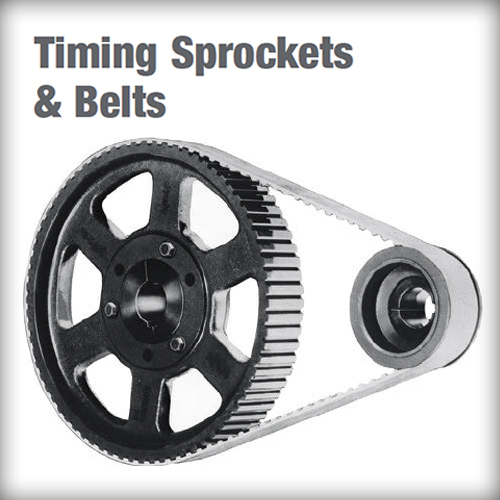
Timing Belt Drives take their place in industry as a highly efficient, job-proved medium for mechanical power transmission. This drive combines the advantages of the chain and gear with advantages of the belt, but without the limitations usually associated with these drives.
Timing Belt Drives make possible important savings in weight, space and construction without the sacrifice of efficiency. They are adaptable to almost any kind of power transmission drive.
Timing Belt Drives are being used by virtually every industry. They have been adopted as standard equipment by a wide variety of machine builders and equipment manufacturers.
• Positive—Slip-Proof
Positive grip of belt teeth with sprocket grooves eliminates slippage, speed variation. There’s no initial stretch, no elongation to require belt take-up.
Positive grip of belt teeth with sprocket grooves eliminates slippage, speed variation. There’s no initial stretch, no elongation to require belt take-up.
• No Lubrication
Absence of metal-to-metal contact eliminates the need for lubricating systems, oil-retaining devices—and their nuisance, cost, weight, and possibility of product contamination.
Absence of metal-to-metal contact eliminates the need for lubricating systems, oil-retaining devices—and their nuisance, cost, weight, and possibility of product contamination.
• Wide Capacity Range
The load capacities of synchronous belt drives range from subfractional horsepower to 600 hp and up.
The load capacities of synchronous belt drives range from subfractional horsepower to 600 hp and up.
• Freedom From High Tension
Since the synchronous belt drive does not rely on friction, there is no need for high tension. Thus, overhung bearing loads are reduced to a minimum.
Since the synchronous belt drive does not rely on friction, there is no need for high tension. Thus, overhung bearing loads are reduced to a minimum.
• Constant Angular Velocity
Speed is transmitted uniformly. There is no chordal rise and fall of pitch line as with roller chain, no belt creep or slippage—thus no chatter or vibration.
Speed is transmitted uniformly. There is no chordal rise and fall of pitch line as with roller chain, no belt creep or slippage—thus no chatter or vibration.
• Compact Design
Small sprockets, short centers, narrow belts, high capacity—all these inherent features can be combined to reduce space requirements.
Small sprockets, short centers, narrow belts, high capacity—all these inherent features can be combined to reduce space requirements.
• Minimum Backlash
Because of advanced design, backlash—between the teeth and the stock belts and the grooves of stock sprockets—is reduced to a negligible minimum.
Because of advanced design, backlash—between the teeth and the stock belts and the grooves of stock sprockets—is reduced to a negligible minimum.
• High Efficiency
Three factors—inherent elimination of friction, lack of high tension, and the belt’s thin construction— contribute to the drive’s unusually high mechanical efficiency.
Three factors—inherent elimination of friction, lack of high tension, and the belt’s thin construction— contribute to the drive’s unusually high mechanical efficiency.
• Light Weight
The horsepower-to-weight ratio is high—an important consideration where weight is a critical factor, as on portable equipment.
The horsepower-to-weight ratio is high—an important consideration where weight is a critical factor, as on portable equipment.
• Economical Operation
By comparison with other systems, a synchronous belt drive generally is the least costly. The cost of the drive itself is the only expense. Synchronous belt drives do not require motor bases, lubrication systems or tensioning devices. Maintenance costs are minimal.
By comparison with other systems, a synchronous belt drive generally is the least costly. The cost of the drive itself is the only expense. Synchronous belt drives do not require motor bases, lubrication systems or tensioning devices. Maintenance costs are minimal.
Reviews
There are no reviews yet.